Customer Case Study · Cloud & DevOps
Project KubeShift
PaaS-to-Kubernetes Application Modernization
A cloud-native modernization initiative that migrated a production-style application from PaaS to Kubernetes — introducing containerization, automated delivery, health-aware orchestration, autoscaling, and a repeatable operating model.
Before
· PaaS-managed deployment
· Limited platform control
· Platform-dependent scaling
· Manual / platform workflow
· PaaS-centric operations
After
✓ Automated Kubernetes delivery
✓ Containerized, portable runtime
✓ Kubernetes autoscaling policies
✓ CI/CD-driven release pipeline
✓ Declarative Kubernetes operations
Business Challenge
The existing PaaS deployment was effective for getting the application online, but the customer needed greater infrastructure control and a platform model that could support standardized delivery across environments.
Key concerns included portability, predictable release processes, scaling controls, application health management, and reducing dependence on provider-specific runtime behavior.
Modernization Approach
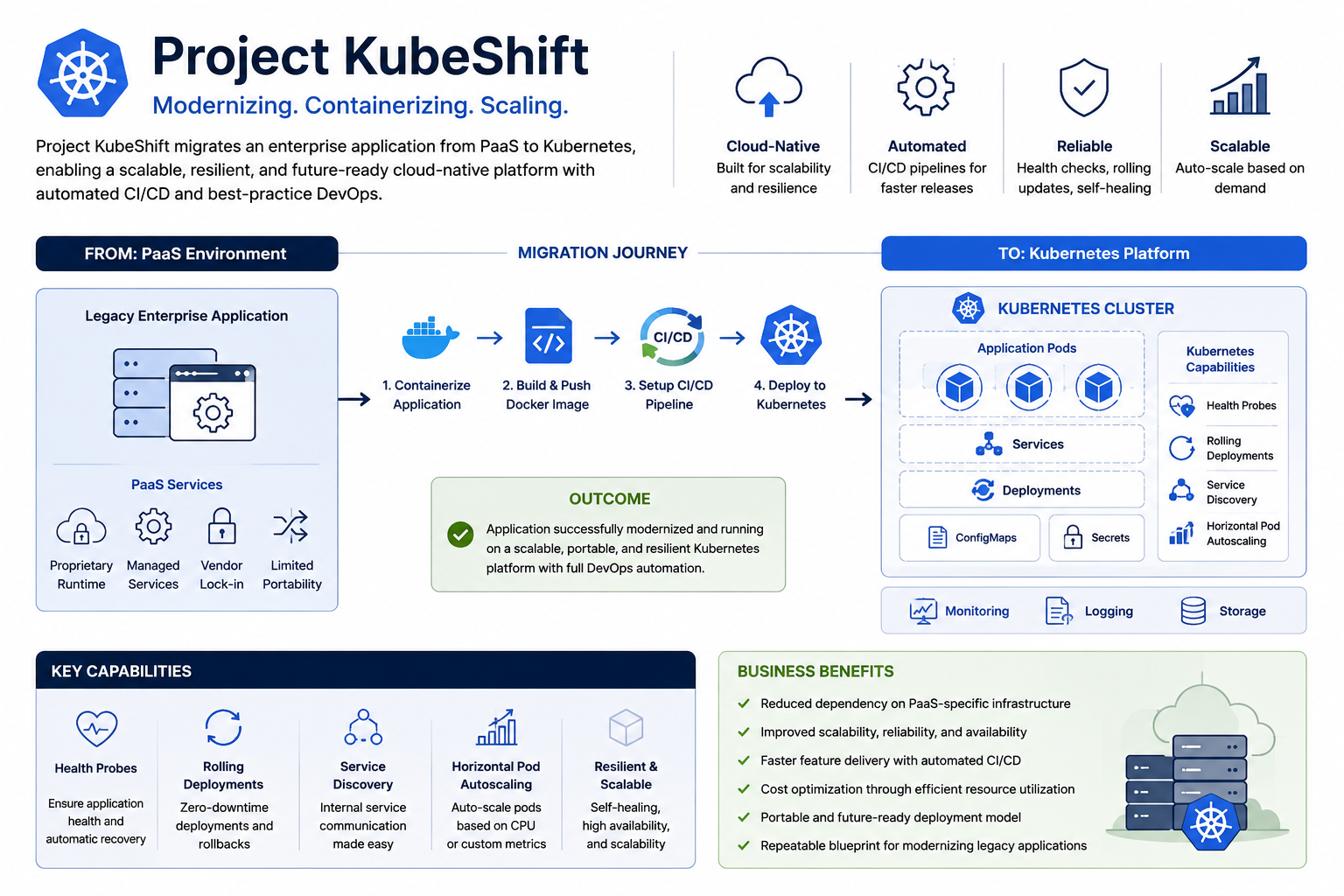
The migration was executed as an incremental modernization rather than a rewrite. The application was first packaged into a reproducible container image, then introduced into a Kubernetes environment with configuration, networking, health checks, and scaling defined declaratively.
The target architecture packages the application as a container image and runs it as a Kubernetes workload behind a service and ingress layer. CI/CD automation builds, validates, publishes, and deploys versioned artifacts, while Kubernetes health probes and autoscaling provide resilience and elastic capacity.
Migration Phases
01 — Assess: Reviewed the PaaS deployment, application runtime, configuration, ports, dependencies, and operational assumptions.
02 — Containerize: Created a reproducible container image and validated the application locally and in a controlled environment.
03 — Kubernetesize: Defined Deployment, Service, configuration, health probes, resource policies, and ingress/networking.
04 — Automate: Connected source changes to automated build, test, image publication, and deployment workflows.
05 — Harden: Introduced autoscaling, health-aware traffic routing, controlled rollouts, and environment-specific configuration.
06 — Validate: Performed functional, deployment, resilience, and scaling validation before treating Kubernetes as the target runtime.
Key Engineering Decisions
Immutable application artifacts: each release is represented by a versioned container image.
Declarative infrastructure: desired application state is defined through Kubernetes manifests.
Health-aware traffic: readiness controls whether a pod receives traffic; liveness supports recovery.
Horizontal scaling: additional replicas can be introduced when demand crosses configured thresholds.
Separation of configuration from code: environment-specific values are externalized from the image.
Repeatable delivery: the same pipeline pattern can be reused for future services and environments.
Results & Customer Outcomes
Platform portability: application packaged as a container and deployed through Kubernetes — reduced dependency on PaaS-specific runtime behavior.
Deployment consistency: automated, versioned delivery workflow — fewer manual deployment steps and repeatable releases.
Elasticity: horizontal pod scaling enabled — capacity can respond to changing workload demand.
Resilience: readiness/liveness checks and replica-based recovery — improved application availability behavior.
Scalability of delivery: reusable Kubernetes deployment pattern — foundation for migrating additional applications.
Conclusion
Project KubeShift demonstrates how an application can move from PaaS to Kubernetes without treating migration as a simple hosting change. The value comes from combining containerization with automation, declarative orchestration, health-aware operations, and elastic scaling.
The resulting platform provides a stronger foundation for standardization, portability, resilience, and future cloud-native growth. Beyond the technical migration, the initiative created a repeatable modernization blueprint — future applications can follow the same path.
Ready to modernize?
Let's talk about your infrastructure.
We'll assess your current setup and come back with a clear plan within 24 hours.